Day 1
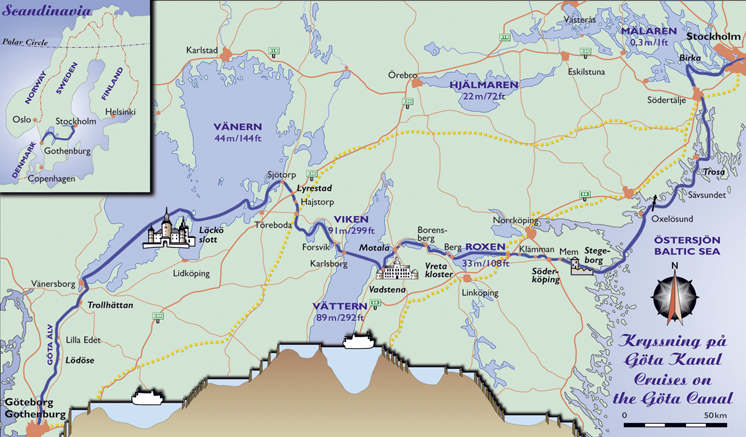
11.30 Departure from Söderköping - The idyllic town Söderköping was founded in the early 1200s and was very important during the
Hanseatic period. The town also has a long and very interesting history as a spa. Don’t forget to try
the famous ice cream! 12.00 - 13.30 Duvkullen–Mariehov–
Carlsborg
There are eight locks in the short distance of around two kilometres. Take the opportunity to
stretch your legs between the locks. 14.45 - 15.15 Lake Asplången - 27 metres above sea level. 16.45 - 17.00 Norsholm lock -Here the canal crosses the main railway line between Stockholm and Malmö. 17.00 - 20.15 Lake Roxen - 33 metres above sea level. 17.15 - 18.45 Runstorp - Runstorp is a manor house dating from Sweden’s period of greatness. The owners Louise and Eddie
Uggla take us on a tour of their house with its Gustavian drawing room and interesting library, all
while relating anecdotes from its history. Runstorp is not open to the public, which makes this an
exclusive visit. 20.15 - 21.15 Berg (Carl-Johan) - The Carl-Johan lock staircase is the longest in the canal with seven connected locks. At Berg there is
a system of a total of 15 locks. 21.15 Arrival in Berg
(the basin)
We dock for the night in the harbour basin between the locks of Carl-Johan and Oscar. The evening
offers the possibility to take a walk along the canal, or to go for an evening swim in Lake Roxen
below the Carl-Johan lock staircase.
Day 2
07.55 Dep. Berg
(the basin)
We leave the harbour basin and continue our ascent in the Berg lock system. 08.00 - 08.30 Berg (Oscar)
Four locks take us up to the road bridge at Berg. Here it is possible to take a walk along the canal to
the Vreta convent ruins and church.
The convent of Vreta dates from about 1100 and was the first nunnery in Sweden. Its importance
was later superseded by the convent founded by Saint Bridget (St. Birgitta) at Vadstena. The old
convent church at Vreta is one of Sweden’s most interesting, offering many medieval treasures.
Today, it serves as a parish church and is therefore not always open to visitors. 08.45 - 09.30 Berg
(Brunnby/Heda)
This stretch of the canal is regarded as one of the most beautiful with its views over Lake Roxen. 09.30 - 12.45 Långkanalen - We travel 20 kms without passing any locks through the astonishing Östgöta scenery. We pass two
aqueducts, eight bridges, Ljung castle and Brunneby manor. 09.45 Ljungsbro,
aqueduct
Two more recent aqueducts have been built to carry the canal. The Ljungsbro aqueduct was built in
1970 over the new road into the community. 12.20 Kungs Norrby,
aqueduct
The aqueduct at Kungs Norrby was built in 1993 as part of the national route 36. Shortly after the
aqueduct there is a small gazebo leaning out over the canal in the sharp Västanå Bend, also known
as the “Helmsman’s Horror”. 12.45 - 13.00 Borensberg - Borensberg has one of the canal’s hand-operated locks. Right by the lock you can also see the wellknown
Göta Hotel from 1908. 13.00 - 14.00 Lake Boren - 73 metres above sea level. 14.00 - 14.45 Borenshult - Lock staircase of five locks where you might hear the nightingale sing. 15.30 - 15.45 Lake Vättern - We take a little jaunt on Lake Vättern, 89 metres above sea level, to get a better view of Motala. 16.00 Arrival in Motala It was Baltzar von Platen who drew up the plans for Motala, and today it is called “the Capital of
the Göta Canal”. In 1822 an engineering works, Motala Werkstad, was established here to serve the
canal, and is today considered to be the cradle of Swedish industry. Here you also find the head
office of the Gota Canal Company, as well as a number of museums, including the well-known
Motor Museum. Our cruise ends here.
%20copy.jpg)