Gothenburg to Stockholm - 6 days
|
For further assistance call 1-800-526-8539 |
| |
Ask about our Travel Insurance |
Detailed Itinerary: |
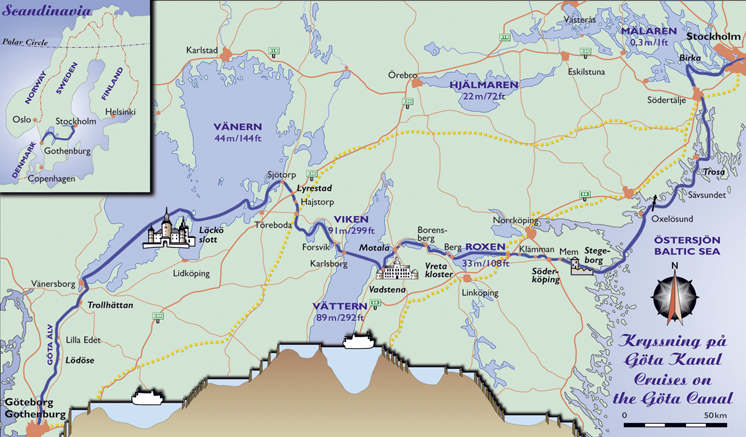
Two seas, one river, three canals, eight lakes and 66 locks.
Day 1
10.00hrs Departure from Gothenburg, Packhuskajen 10
14.15-14.30 Lilla Edet
The lock at Lilla Edet, built in 1916, is the first on our journey. The
original lock was opened in 1607 and was the first lock in
Sweden
.
15.45-16.30 Trollhättan, locks
The impressive lock staircase at Trollhättan consists of four locks, and has a total drop of
32 metres
. Of the three parallel lock systems here, only the biggest one (from 1916) is still in use.
16.30-18.30 Trollhättan
The
Trollhättan
Canal
Museum
is located in a storehouse from 1893. Learn more about the fascinating history of the
Trollhätte
Canal
through the interesting exhibition and film shown here. You can also take a walk through the beautiful old lock area.
19.30hrs Arrival in Vänersborg
This is the last town before we head out to Lake Vänern. The “Brinkebergskulle” lock is just
before Vänersborg. Overnight stop.
Day 2
04.45hrs Departure from Vänersborg
04.45-15.15 Lake Vänern
44 metres
above sea level.
Sweden
’s largest lake and the third largest lake in Europe, after the Ladoga and Onega lakes in
Russia
.
09.30-11.45 Läckö Castle
The Castle was built in 1298 as a bishop’s residence. Its golden age was during the reign of Magnus Gabriel de
la Gardie
,
who transformed it into a baroque castle in 1652. We are given a guided
tour of the castle and the exhibitions (lots of stairs). App.
1 km
walk.
15.15-16.45 Sjötorp
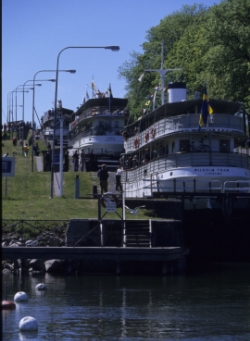
We now enter the first of the 58 narrow locks on the
Göta Canal
.
At Sjötorp we have a set of eight locks and also the remains of some
old shipyards. Here you can take a walk alongside the canal while our
ship slowly travels up the locks.
17.45-18.35 Lyrestad
Jema Studioglas is located right by the canal and the guest harbour of Lyrestad. Here we experience at
close hand the transformation of art glass sculpture from molten glass to its solid form.
19.45 - 21.20 Godhögen–Hajstorp övre
We pass a lock system consisting of four locks in very beautiful surroundings. In 1822 the western
section of the Göta Canal was inaugurated at Hajstorp. After dinner we will be entertained by a music group.
21.20hrs Arrival in Hajstorp
At Hajstorp our ship berths for the night, close to what used to be the Canal Engineer’s home, now privately owned. Overnight stop.
Day 3
06.00hrs Departure from Hajstorp
07.00 Töreboda
The railway line between
Stockholm
and Gothenburg crosses the canal here. Töreboda also proudly presents
Sweden
’s smallest ferry, "Lina", which travels back and forth across the
Göta Canal
.
09.00 The Berg Canal/the Obelisk
An obelisk marks the highest point (
91.5 metres
above sea level) of the canal. This part of the canal is called the
Berg
Canal
and originally had a sharp bend which was straightened in 1930-33.
10.00 Tåtorp
One of the canal’s two hand-operated locks is found at Tåtorp.
10.00-12.15 Lake Viken
The beautiful
Lake
Viken
(
91.8 metres
above sea level) serves as a water reservoir for the western section of the
Göta Canal
.
11.10-12.15 The Spetsnäs Canal/Billströmmen
We steer through two narrow, wood-lined passages and small lakes full of water lilies.
12.15-12.35 Forsvik
Forsvik has a very interesting industrial history. The lock, built in
1813, is the oldest one in the canal. The impressive iron bridge dates
from the same year. In the lock we are greeted with songs and flowers
by the Kindbom family, a religious group. From here on we will be going
downwards!
13.15 Karlsborg
Before our ship enters
Lake
Vättern
, we pass Karlsborg and will be able to see the roof of the fortress, which was built in 1819-1909.
13.15-15.00 Lake Vättern
89 metres
above sea level.
Sweden
’s second largest and also deepest lake (
128 metres
deep).
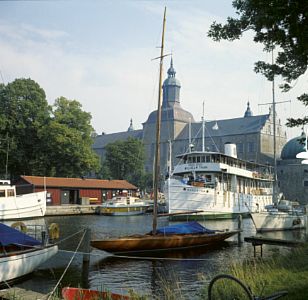
15.00-18.00 Vadstena
Today Vadstena is an idyllic little town. It evolved around the 14th
century convent of the Saint Bridget (St. Birgitta), becoming a
spiritual, cultural and commercial centre. The Abbey was built
according to St. Bridget’s plans, and was consecrated in 1430. The
Castle was built in the 1540s by King Gustav Vasa. Local guides will
meet us and take us with the sightseeing train to see the Abbey and the
castle. You will also have time here to walk around the town on your
own, or go for a swim in the lake.
19.45hrs Arrival in Motala
It was Baltzar von Platen who drew up the plans for Motala, and today it is called "the Capital of the
Göta Canal
". In 1822 an engineering works, Motala Werkstad, was established here to serve the
Göta Canal
and is today considered to be the cradle of Swedish industry. Here you
also find the head office of the Gota Canal Company, responsible for
operation and maintenance. We visit the
Motor
Museum
,
with its large exhibition of antique cars and motorcycles in authentic
surroundings, collection of radios, toys, household appliances and
more. You can also walk to see Baltzar von Platen’s grave, about
1 km
along the left side of the canal. Overnight stop.
Day 4
08.00hrs Departure from Motala
Possibility to take a beautiful morning walk from Motala to Borenshult, app.
4 km
.
09.00-09.40 Borenshult
Lock staircase of five locks where you might hear the nightingale sing.
09.40-10.40 Lake Boren
73 metres
above sea level.
10.40-11.40 Borensberg
At Borensberg there is another hand-operated lock. We walk the short
distance to the well-known Göta Hotel, from 1908, where we are served
coffe and waffles.
12.00 Kungs Norrby, aqueduct
The aqueduct at Kungs Norrby was built in 1993 and leads over the national route 36.
14.40 Ljungsbro, aqueduct
We pass the second aqueduct on our journey. This one was built in 1970.
15.00 Berg (Heda)
At Berg we pass through a system with a total of 15 locks. The convent of Vreta dates from about 1100 and was the first nunnery in
Sweden
.
Its importance was later superseded by the convent founded by Saint
Bridget (St. Birgitta) at Vadstena. The old convent church at Vreta is
one of
Sweden
’s
most interesting, offering many medieval treasures. Today, it is used
as a parish church and is therefore not always open to visitors. The
tour guide will take you on a walk (app.
3 km
,
partly uneven) to see the church and the remains of the convent. As an
alternative you can walk along the canal or take a swim in the warm
water of
Lake
Roxen
.
16.30-17.30 Berg (Carl-Johan)
The Carl-Johan lock staircase is the longest in the canal with seven
connected locks. Here we board the ship again before steering out on
the lake.
17.30-19.30 Lake Roxen
33 metres
above sea level.
19.30 Norsholm lock
Here the canal crosses the main railway line
Stockholm
– Malmö.
Lake Asplången
27 metres
above sea level.
22.00hrs Arrival in Klämman
We stop for the night at the idyllic lock Klämman, a water regulating
lock. Take the opportunity to enjoy the total stillness. Overnight stop.
Day 5
07.30hrs Departure from Klämman
08.20-09.30 Carlsborg–Mariehov–Duvkullen
At the lock Carlsborg Övre we have the first of the nine locks taking
us down to Söderköping. Here you can stretch your legs between the
locks, or, if you want more exercise, walk all the way down to
Söderköping, app.
4 km
.
10.00-12.30 Söderköping
The idyllic town Söderköping was founded in the early 1200s and was
very important during the Hanseatic period. The town also has a long
and interesting history as a spa. Söderköping is yours to explore on
your own. Don’t forget to try the famous ice cream!
14.00 Mem
Passing through the last narrow lock before Slätbaken, an inlet of the Baltic, we leave the
Göta Canal
. On 26th Sept. 1832, the
Göta Canal
was inaugurated at Mem amid great pomp and circumstance in the presence of King Karl XIV Johan and his family.
14.00- The Baltic
We cross open water for a short bit and then weave through the archipelago.
15.00-16.00 Stegeborg
The ruins of the Stegeborg Fortress are beautifully situated on a small island overlooking the
bay
of
Slätbaken
.
The fort was constructed during the early Middle Ages and was built to
guard the inlet to Söderköping. We are given a guided tour through the
interesting history of Stegeborg. The walk is short, but somewhat
uneven.
20.30hrs Arrival in Sävsundet
We await dawn at the old pilot station. Overnight stop.
Day 6
04.40hrs Departure from Sävsundet
08.10-08.20 Södertälje
Södertälje lock,
135 metres
long, is the largest lock in
Scandinavia
.
08.20-14.50 Lake Mälaren
0.3 metres
above sea level.
Sweden
’s third largest lake.
09.45-11.45 Birka
The Viking community of Birka on the
island
of
Björkö
is often regarded as
Sweden
's
first town. The town was then an important harbour for international
shipping and trade. It was in use for about 250 years and was abandoned
before the year 1000. Birka features on UNESCO’S World Heritage list.
The archaelogists on the island show us around (app.
3 km
, uneven terrain). We also visit the museum.
13.45 Drottningholm Castle
Drottningholm
Castle
, home of the Royal family since 1981, is also found on the World Heritage list. We pass the castle if time admits.
15.00 Hammarby lock
The final lock on our journey delivers us from
Lake
Mälaren
into Saltsjön.
15.30hrs Arrival in Stockholm, Skeppsbrokajen
Our cruise ends at Skeppsbrokajen
103, in
the Old Town of Stockholm.
Subject to changes. Please Note! All times stated are approximate. |
 copy.jpg)